
Montgomery County Court Records After Arrest
After a Montgomery County arrest, the jail booking record and the court case are two different records. The jail creates intake and custody information: booking number, booking photograph, fingerprints, bond information if available, and custody status. The formal court record develops when the prosecuting attorney files charges in court. Montgomery County is part of Missouri's 12th Judicial Circuit, which includes Audrain, Montgomery, and Warren counties, and the county elected-officials page names Paul Boyd as Prosecuting Attorney.
That separation matters for searches. A person can appear in jail custody before Case.net shows a filed case. A booking charge can also differ from the charge the prosecutor later files, amends, reduces, or dismisses. Use jail inmate records for custody, booking, bond, and release questions. Use court records after a jail arrest for filed charges, hearing dates, docket entries, warrants, and final case outcomes.
Search Court Records After Montgomery Arrest
The main online court route is Missouri Case.net. It is the official Missouri Judiciary portal for public case lookup. Search by case number when booking paperwork or a court notice lists one. Search by litigant name when the case number is not known. Filing date search can help when the name is common and the arrest date is known. Judgment index search is more useful after final disposition.
- Confirm the person was booked into the Montgomery County Jail and note the arrest date if available.
- Open Case.net and search by litigant name, using full legal name and spelling variants.
- Narrow to Montgomery County or the 12th Judicial Circuit when the portal offers that filter.
- Open the case result and review parties, charges, docket entries, bond entries, hearings, judge, attorneys, and disposition.
- If no case appears, check again later or contact the Montgomery County Circuit Clerk.
The Case.net portal screenshot source is the official search starting point for court records after a jail arrest.
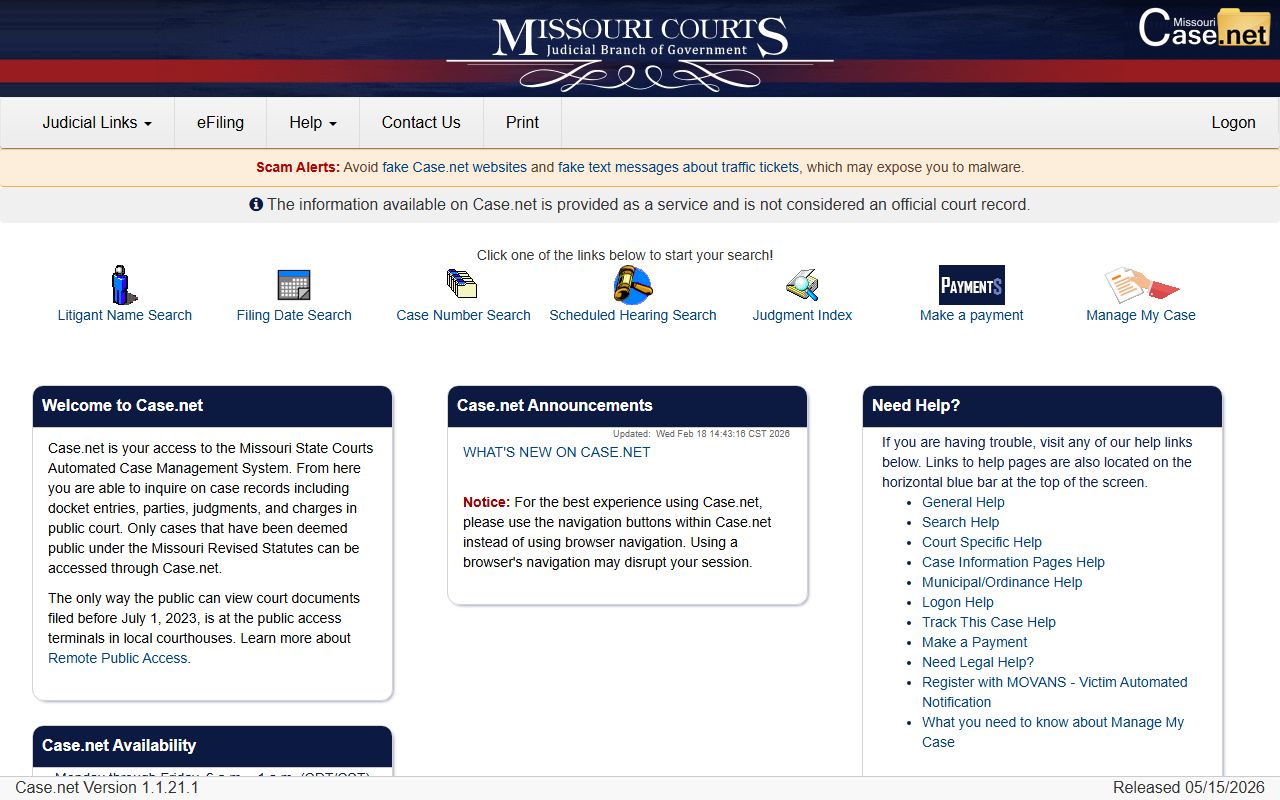
Case.net is separate from the sheriff app, so it should be used for filed court charges rather than same-day custody confirmation.
Montgomery County Court Search Fields
Case.net is broader than the county jail route. It searches Missouri court records, so the right search category depends on what the user already knows. A case number is the most precise. A name search is common after a jail arrest because the person may only have a booking name at first. Filing date can narrow a search when a recent arrest date is known, while judgment index is mainly helpful after a final outcome.
| Field or Category | Type | Best Use | Notes |
|---|---|---|---|
| Case Number Search | Search category | Known case number | Best when court paperwork lists the number. |
| Litigant Name Search | Search category | Defendant name | Use first and last name, then narrow by county or circuit. |
| Filing Date Search | Search category | Known arrest or filing window | Useful for common names. |
| Judgment Index | Search category | Disposed cases | More useful after judgment or disposition. |
| Track This Case | Portal action | Updates and reminders | Available for some cases through official court tools. |
Charging Documents After a Jail Arrest
Montgomery County court records after a jail arrest can start through more than one charging document. A complaint may begin a criminal case based on facts supplied by law enforcement and reviewed by the prosecutor. An information is a formal prosecutor-filed charging document used in many Missouri criminal cases. An indictment comes from a grand jury. A booking charge is only the arrest or intake label. The prosecutor may later file a different charge, add counts, reduce a charge, or decline prosecution.
| Document | Filed By | Common Role | Why It Matters |
|---|---|---|---|
| Complaint | Officer or prosecutor process | Early charging step | May appear near the start of the case. |
| Information | Prosecuting attorney | Formal charging document | Often controls the filed charge list. |
| Indictment | Grand jury | Grand-jury charge | Can start or replace a filed charge path. |
Charge Status in Court Records
Charge status is not static. Court records after a jail arrest may show pending charges at first, then amended charges, dismissed counts, guilty pleas, trial outcomes, probation, suspended imposition of sentence, suspended execution of sentence, or acquittal. A charge is an accusation. A conviction is a final outcome after plea or trial. For people comparing jail records to court records, the safest reading is that the court file controls the filed criminal case while the jail file controls custody.
| Status | What It Means |
|---|---|
| Pending | The charge is filed but not finally resolved. |
| Amended | The prosecutor or court changed the charge wording, count, or level. |
| Reduced | The case moved to a less serious charge or lower level. |
| Dismissed | The charge was ended without conviction on that count. |
| Nolle prosequi | The prosecutor declined to continue that charge. |
| Disposed | The court has entered a final outcome for the charge or case. |
Bond Records After Montgomery Arrest
Bond links the jail record to the court record. The sheriff publishes a local bonding page that says callers need the detainee name, booking number, and cash bond amount. Payment goes through Court Money, with Visa, MasterCard, and Discover listed as options. The page says payments are available 24 hours a day, seven days a week, and handling fees apply. The jail cannot proceed with bonding until it receives correct notification from Court Money.
| Bond Type | How It Works |
|---|---|
| Cash bond | Money is paid through the court or vendor process for release eligibility. |
| Surety bond | A licensed bondsman posts surety; the jail page notes compliant detainees may call a bondsman. |
| Personal recognizance | Release on promise to appear, when allowed by the court. |
| No-bond hold | Payment alone will not release the person because a court or agency hold controls custody. |
| Outside-agency hold | Another county, state, federal, probation, parole, or immigration hold may delay release. |
The official bonding procedure source shows the Court Money route and required detainee details.

Bond entries on the court side should be compared with jail custody status because warrants or holds can still block release.
Warrants After Montgomery County Arrest
No official Montgomery County public warrant-search form was located on the sheriff website. The practical route is to call the Sheriff's Office, the jail, or the court. A bench warrant may appear in Case.net docket text, depending on public access and case type. A warrant can lead to jail booking, and RSMo 221.510 requires warrant checks before release or transfer from jail.
| Channel | Use | Contact or Location |
|---|---|---|
| Sheriff Office | Non-emergency warrant routing | 573-564-8084 |
| Jail | Custody and hold questions | 573-564-8086 |
| Case.net | Case and docket search | Missouri Judiciary portal |
| Circuit Clerk | Court warrant and case questions | 211 E. 3rd St., Suite 301; 573-564-3341 |
Charges, Convictions, Sealed Records
A Montgomery County arrest record is not the same as a conviction. A person can be arrested and released without charges, charged and later dismissed, or convicted after a plea or trial. Missouri law also controls when records become closed or expunged. RSMo 610.120 addresses closed-record handling, while RSMo 610.140 sets expungement rules for qualifying records.
| Charge | Conviction | |
|---|---|---|
| Stage | Accusation filed in court | Final result after plea or trial |
| Meaning | Not proof of guilt | Court-found or plea-based guilt |
| Can change? | Yes, charges may be amended or dismissed | Usually changes only through appeal, set-aside, or later court order |
Sealing and expungement are related but not identical concepts. Missouri statutes use specific rules and eligibility limits. A court order, not a sheriff app entry, controls whether an eligible record is closed under state law.
| Closed / Sealed | Expunged | |
|---|---|---|
| Public access | Removed from ordinary public access when law or order requires it | Closed under the expungement order for qualifying records |
| Agency access | May remain available to specified agencies | Handled under RSMo 610.140 and 610.120 limits |
| Best source | Circuit Clerk or court order | Circuit Clerk, court order, and affected record-holding agencies |
Restricted Court Records After Arrest
Some court records after arrest will not appear in a public search. Reasons include juvenile confidentiality, sealed or expunged cases, active investigative restrictions, victim-safety redactions, dismissed cases that become closed under Missouri law, or older records that require clerk assistance. RSMo 610.100 says if a person is arrested and not charged within 30 days, the arrest report thereafter becomes a closed record except for disposition access and other statutory exceptions.
Important: A public lookup is not a consumer report and should not be used for FCRA-covered decisions.